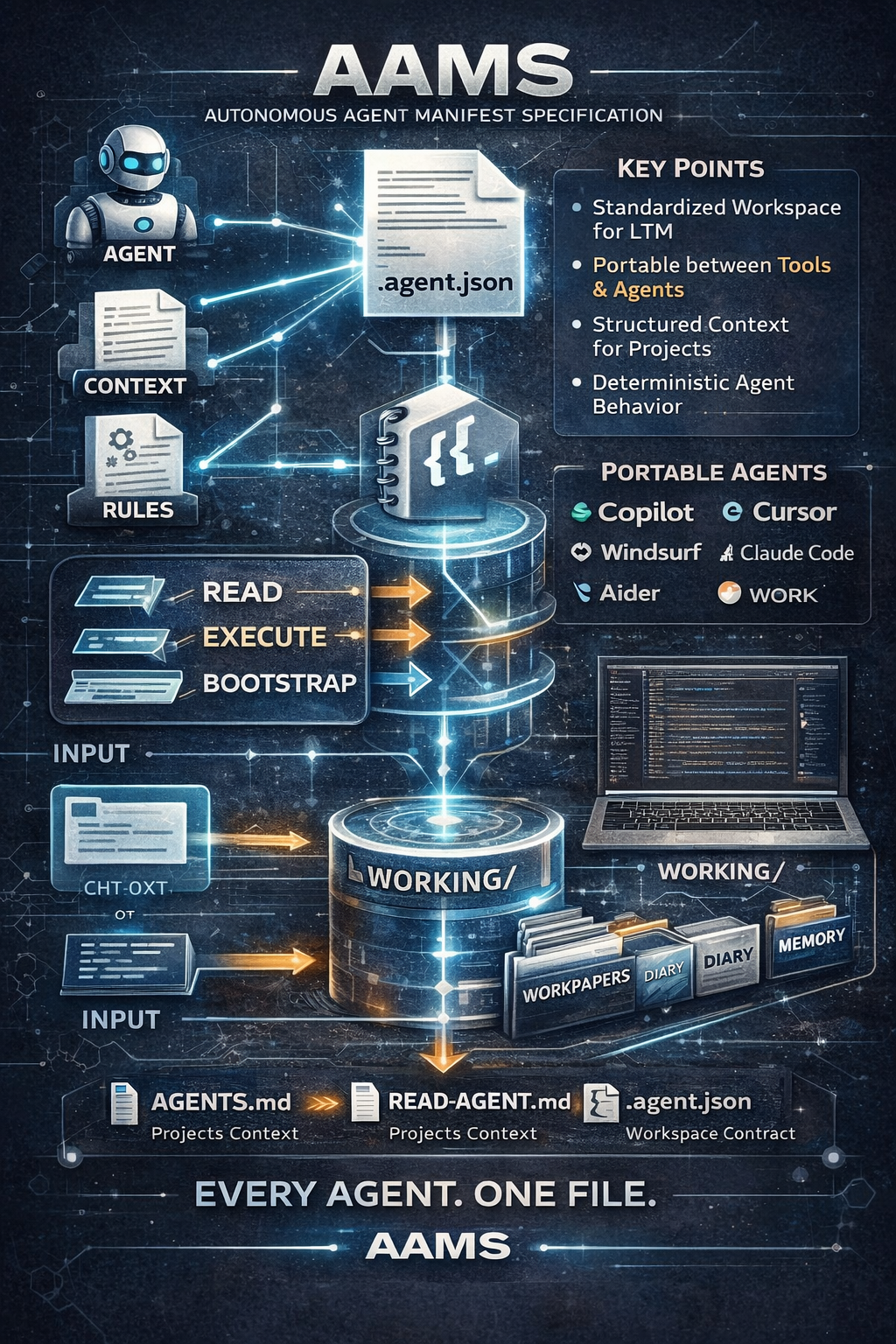
Autonomous Agent Manifest Specification

Every
Agent.
One File.

AI agents don't forget — but project knowledge belongs to the tool, not the project. AAMS gives your repo memory, structure, and continuity. One single file. No framework. No lock-in.

bash — step 1 of 1
$ curl -sO https://raw.githubusercontent.com/DEVmatrose/AAMS/main/.agent.json
1
File
0
Dependencies
8+
Compatible tools
Sessions with context
40s
Setup time

Your agent forgets.
So does your project.

Switch tools — session 47 is gone. Switch team members — the context goes with them. The problem isn't that agents forget. The problem is that project knowledge doesn't belong to the project.

🔄
Tool lock-in

Session persistence lives in the tool's cloud, in their format, bound to their ecosystem. Switch the tool — start from zero.

🌀
Context drift

At 5 sessions you remember everything. At 50 you re-decide things from two months ago. At 100 your agent hallucinates.

👻
Tribal knowledge

"Ask Stefan, he knows." The repo doesn't speak for itself. No audit trail. No traceable decisions.

"A repo without agent structure is like a ship without a logbook. Everyone knows what they did yesterday. Nobody knows what came before."

The Core Loop

AAMS is not a tool. Not a runtime. Not a framework. AAMS is a structured context and decision compiler for agents — packaged as a single file in the repo root.

Output
Documentation
Decision
Memory
new Context
📋
Workpapers

Every session is a markdown document in WORKING/WORKPAPER/. Timestamped. Searchable. Permanent.

🧠
Long-term memory

ltm-index.md accumulates context across sessions. The agent queries memory before it acts.

⚖️
Decision log

Every architecture decision is traceable. git log + grep WORKING/ = full audit trail.

One file.
Everything included.

.agent.json in your repo root. An agent that reads this file immediately knows everything it needs.

📄 .agent.json AAMS/1.0
Workspace contract — where documentation goes, how sessions are structured
Memory routing — where long-term memory lives, how it is queried
Bootstrap rules — what the agent should do on first start, on_session_start, on_first_entry
Permission scope — what it may do, what it must not. Not an actor. A deterministic worker.

Every tool has its own conventions. AAMS replaces them all with one bridge file. No CLAUDE.md. No GEMINI.md. No airules.md.

🌉
AGENTS.md
Read by all major AI tools — Copilot, Cursor, Claude Code, Codex, Windsurf
📖
READ-AGENT.md
Project context and agent contract — full project state
⚙️
.agent.json
Bootstrap rules and workspace structure — machine-readable
Copilot Cursor Claude Code Codex Windsurf Aider Continue.dev Firebase Studio

Projects using AAMS

From autonomous agent frameworks to festival websites. Projects that show what's possible when a repo speaks for itself.

→ View showcase & add your project

You've used
AAMS?

What worked? What didn't? Which tool, which session size, which project? Real reports from the field make the standard better.

⚑ Submit report as issue

// What we're interested in

01 Tool + setup: Which agent, which project setup did you use?
02 What worked: Where did AAMS deliver real value?
03 What was missing: Edge cases, missing fields, unclear rules?
04 Your repo: Optional — can be added directly to the Showcase.

40 seconds.
One file.

No npm install. No pip install. No framework.

01
Fetch the file
curl drops .agent.json directly into your repo root. That's it. One single file.
02
Tell the agent
Tell the agent: Read .agent.json and execute agent_contract.on_first_entry. No further setup.
03
Agent works
The agent creates WORKING/, scans the repo, writes the first workpaper. Done.
Step 1 — the only file you need
$ curl -sO https://raw.githubusercontent.com/DEVmatrose/AAMS/main/.agent.json